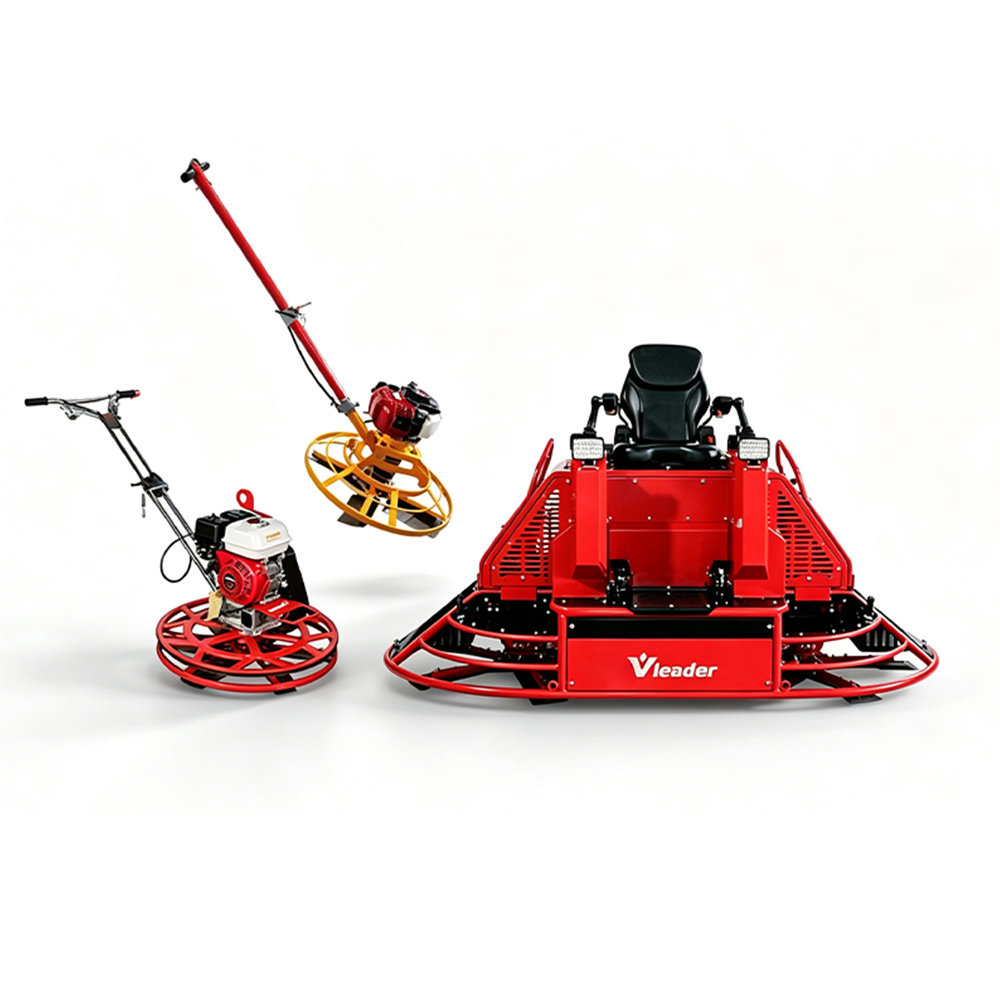
Power trowels are used to finish concrete floors, creating a smoother, more consistent surface with less manual work. Different jobs require different machines: walk-behind models offer maneuverability and direct control, while ride-on machines cover large open areas efficiently.
How a Power Trowel Works
A power trowel uses rotating blades or finishing tools on freshly placed concrete. Finishing has two main stages: floating and finishing.
During floating, the surface is leveled using float blades or pans. As concrete firms up, finishing blades are pitched to apply greater pressure for a smoother, denser finish. Combination blades can handle both stages. Timing is critical—starting too early or too late affects the result.
Walk-Behind Power Trowels
Walk-behind trowels are operated from behind using a handle. They suit smaller areas, confined spaces, and work around walls and columns. They come in various sizes. Vleader’s range includes the compact VLD-424 (24-inch) for smaller areas, and the VLD-630 and VLD-436 series for larger coverage. The VLD-436 has a 915 mm working diameter and 200 m²/h capacity.
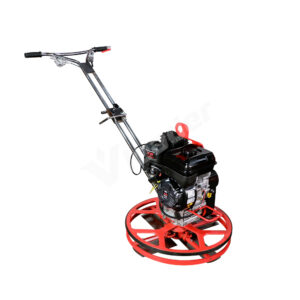
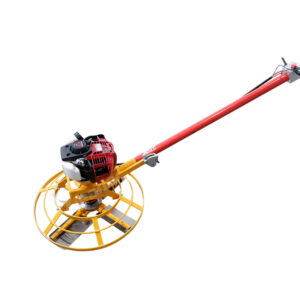
Typical applications: residential floors, smaller commercial floors, confined areas, edges around walls and columns, and projects where transporting a ride-on machine is impractical. A compact walk-behind also complements a ride-on machine on large projects. For resin-bound work, the VLD-424P pole trowel offers a 24-inch diameter and extended handle for remote operation.
Ride-On Power Trowels
Ride-on trowels suit large concrete floors and open areas. The operator sits on the machine, covering more concrete per pass. They are ideal for commercial, industrial, and warehouse floors.
Vleader’s ride-on range includes various sizes and drive configurations. The VLD-1046 has a 2415 mm working size, 10 blades, a 35 HP Briggs & Stratton engine, and 2000 m²/h capacity.
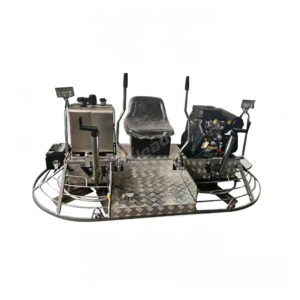
Advantages over walk-behind: larger working area, higher production capacity, greater machine weight, comfortable seated operation, and efficient coverage of large slabs. Actual productivity depends on concrete conditions, operator experience, timing, and blade selection.
Mechanical vs. Hydraulic Ride-On
Mechanical ride-on machines use mechanical systems for steering and blade adjustment. Hydraulic systems use hydraulic components for control and blade operation. Vleader offers both. The VLD-1046FH is full-hydraulic with a hydraulic pump, motors, and pilot handle control. Its 48 HP Yanmar diesel engine, 2400 × 1200 mm working diameter, 10 blades, and 0–200 rpm blade speed suit demanding large-area work. It can also be fitted with grinding plates for floor grinding and polishing.

Walk-Behind vs. Ride-On: Which to Choose?
Walk-behind is suitable when: the area is small, access is limited, obstacles exist, maneuverability matters, direct control is needed, or transport between jobsites is a concern.
Ride-on is appropriate when: the floor is large and open, higher production is required, large slabs are involved, extended finishing periods are expected, or a wider working diameter improves productivity. Some contractors use both: a ride-on for the main floor and a walk-behind for confined areas.
Choosing the Right Size
Match machine size to the surface. A compact 24-inch machine offers maneuverability; larger walk-behind models provide more coverage. For large open floors, ride-on machines with wider diameters reduce passes. Vleader’s range spans the VLD-424, VLD-436 series, and VLD-1046 series. Choose a machine large enough for coverage but practical for the environment.
Choosing Blades and Pans
Float blades — early floating stage; level the surface. Finishing blades — later stage; increased pitch applies more pressure. Combination blades — both floating and finishing. Float pans — broad contact area for floating and leveling large surfaces. Resin blades and pans — for resin-bound applications. Vleader offers all these options to match the tool to the job.
Battery-Powered Power Trowels
Battery power is an alternative to gasoline or diesel. Vleader offers battery options in walk-behind and ride-on configurations. The VLD-436ED is a battery walk-behind model; the VLD-836E is a larger battery ride-on with a 96 V / 210 Ah lithium battery, 15 kW motor, 1920 mm working diameter, and 10 blades. Consider operating duration and charging requirements when matching the machine to the project schedule.
Floor size — small areas suit walk-behind; large slabs suit ride-on. Jobsite access — consider walls, columns, corners, and entrances. Finishing requirements — floating, final finishing, or both. Power system — gasoline, diesel, or battery; consider duration and refueling/charging. Drive and control — mechanical or hydraulic, based on preference. Additional applications — check for attachments like grinding plates (e.g., VLD-1046FH).
Final Thoughts
The right power trowel depends on the job. Walk-behind machines suit maneuverability and access; ride-on machines suit large open areas needing coverage and production. Within each category, choose working size, power source, drive system, and finishing tools.
Vleader’s range covers compact walk-behind equipment, pole trowels, larger walk-behind machines, mechanical and hydraulic ride-on models, and battery-powered options. Rather than choosing by size or horsepower alone, consider the entire process: the concrete surface, working area, access, finishing stage, machine configuration, and blades or pans. Choosing around actual job requirements is the key to efficient, consistent concrete finishing.