
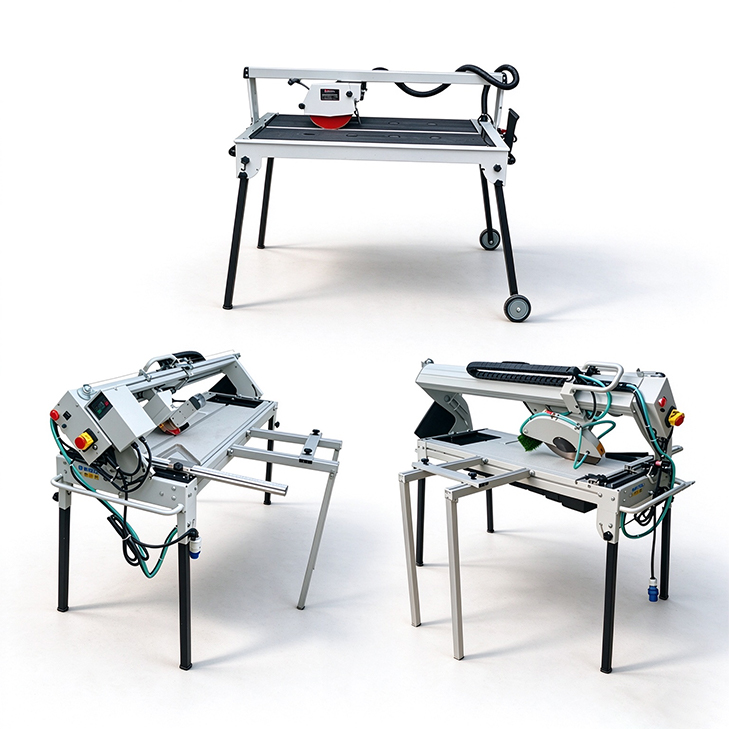
Tile chipping during cutting is a fairly common problem in construction and processing. Especially now that large-format tiles, sintered stone, and vitrified tiles are increasingly widely used, higher demands are being placed on cutting precision and edge quality. Tile cutting machines themselves are not necessarily prone to chipping — the actual result depends directly on tile material, blade quality, equipment stability, cutting speed, and operating method. If parameters are chosen reasonably, the equipment is in good condition, and an appropriate cutting method is used, chipping can be noticeably reduced and the integrity of the cut surface improved.
1. Why Does Tile Chipping Easily Occur During Cutting?
Tile is a hard, brittle material with microscopic pores and structural defects inside. When it is subjected to mechanical cutting or the impact of a high-speed rotating blade, if local stress exceeds what the material can bear, edge chipping occurs easily.
Different tiles differ in hardness, density, and internal structure. Ordinary ceramic tiles, for instance, are relatively easy to process, while high-hardness vitrified tiles, full-body tiles, and some sintered stone place much higher demands on equipment and tooling. If an unsuitable blade is used or the operating parameters are off, problems such as uneven cuts and edge breakage can appear. For tiles of different thickness and material, the right bridge saw should be selected, and blade diameter and maximum cutting depth need to match the material being processed.
2. Blade Quality Directly Affects Chipping
The blade is a key working component of a tile cutting machine. Its sharpness, abrasive type, and manufacturing quality all affect the cutting result.
If the blade is of poor quality, badly worn, or mismatched to the tile material, cutting resistance increases, the impact the blade exerts on the material surface grows, and the risk of chipping goes up.
Therefore, a suitable diamond blade should be chosen according to tile material and thickness. For high-hardness tiles, use a professional blade matched to the material, and replace severely worn blades promptly. Blade selection should match the specific model and the material being processed.
3. Keep the Equipment Running Stably
During operation, obvious vibration, excessive guide rail clearance, or unstable cutting head movement can cause the blade to swing abnormally.
When that happens, the blade cannot cut into the tile along a stable path, the cutting line tends to drift, and local impact force increases.
So before use, check that all connecting parts are secure and that the guide rail, sliding seat, and cutting head run smoothly. Parts with obvious looseness or abnormal wear should be adjusted or replaced promptly. The VBS series uses a double-layer high-strength aluminum alloy guide rail with embedded alloy steel for better wear resistance; some models also feature a high-performance brushless silent motor with continuously variable speed from 9000 to 12000 rpm, which helps keep the cut stable.
4. Control Cutting Speed Reasonably
Cutting speed is another important factor in tile chipping. When it is too fast, the blade bears a heavy cutting load in a short time, concentrating stress on the tile edge.
Too slow is not necessarily better either. If the blade rubs the same area for a long time, it can heat the material locally and hurt the cutting result.
So the feed speed should be chosen according to tile material, thickness, and blade specifications. For harder or thicker tiles, reduce the feed speed appropriately so the blade completes the cut more smoothly. The VBS-150A and VBS-150PRO support automatic, manual, and hand-cranked control, letting the operator adjust feed speed flexibly based on tile material and thickness while balancing quality and efficiency.
5. Wet Cutting Helps Improve the Result
For some tile materials, water-assisted cutting can effectively lower the temperature in the cutting zone and help flush away dust and debris.
If the equipment uses wet cutting, make sure the cooling water supply is normal and the flow covers the effective cutting area. Too little water can raise blade temperature, and a blocked water channel will hurt cooling as well.
Note that not all equipment is suited to wet cutting; choose the method according to the tile cutter’s design and usage requirements.
6. Secure the Tile Before Cutting
If the tile moves or shakes during cutting, chipping is likely.
This is especially true for large-format tiles. With a large panel area, insufficient support can cause slight deformation during cutting. Once the blade cuts in, uneven force on the material can produce cracks near the cut.
So before cutting, place the tile stably on the workbench and make sure the cutting area has sufficient support. For large panels, add support points reasonably to avoid overhang. The workbench size and maximum cutting length of the VBS series vary by model and configuration, so when selecting, confirm that the workbench size and maximum cutting length meet the actual panel specifications.
7. Keep Blade Entry and Exit Smooth
The points where the blade first contacts the tile and where it is about to exit are the areas most prone to chipping.
If the operator suddenly accelerates or applies too much pressure, the blade is likely to produce impact. During entry and exit, keep the motion as smooth as possible and avoid sudden changes in feed speed.
For tiles with higher edge-quality requirements, appropriate pre-cutting and step cutting can also reduce local stress.
8. Keep the Cutting Line Accurate
Before cutting, position accurately according to actual dimensions and check that the cutting line is clear. If the positioning device has an error, forcing a correction during operation can put lateral force on the blade.
So confirm dimensions and cutting direction before the formal cut, keep the tile aligned with the equipment reference position, and let the blade finish the cut along a stable straight line. The VBS-150A, VBS-150PRO, and VBS-400PRO are equipped with laser positioning, which lets the operator confirm the cutting line visually before cutting and reduces forced corrections caused by positioning errors.
9. Maintain the Tile Cutting Machine Regularly
Beyond operating factors, daily maintenance matters just as much. Check the motor, blade, guide rail, bearings, workbench, and cooling system regularly.
If abnormal noise, obvious vibration, or reduced cutting precision appears, stop the machine and inspect it promptly. Do not keep running faulty equipment — it not only causes chipping easily but can also damage the blade and even affect operational safety. The VBS series’ double-layer aluminum alloy guide rail with embedded alloy steel is designed to maintain precision and wear resistance over long-term use, but the guide rail and transmission parts should still be key checkpoints in daily maintenance.
10. Vleader Bridge Saw Product Overview
Vleader currently offers four bridge saws, covering everything from DIY economic models to professional large-slab processing.
1. VBS-230: DIY Economic Model
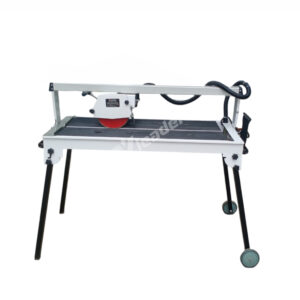
The VBS-230 is a bridge saw aimed at the DIY market and economical processing scenarios. It comes with a 1.2 kW motor and a Ø230 mm blade, with a maximum cutting depth of 40 mm, a maximum cutting length of 1000/1200 mm, a workbench size of 1060/1255×510 mm, and a net weight of 60 kg. It supports 45° mitre cutting, making it suitable for routine cutting of medium-thickness panels — a practical choice for entry-level users.
2. VBS-150A: Professional Three-in-One Model
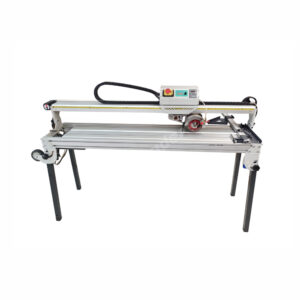
The VBS-150A targets the professional market. It is equipped with a 1.2 kW motor and a Ø120-150 mm blade, with a maximum cutting depth of 20-40 mm, a maximum cutting length of 1200/1600/2500/3000 mm, a workbench size of 1310×500 mm, and a net weight of 46 kg. Its key selling points are laser positioning for automatic cutting and three-in-one cutting — it supports automatic, manual, and hand-cranked control, making it suitable for all types of ceramic tiles and construction materials.
3. VBS-150PRO: Professional Upgraded Model
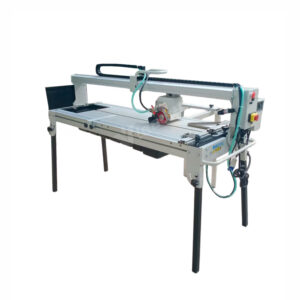
The VBS-150PRO is the upgraded version of the VBS-150A. It also features a 1.2 kW motor and a Ø120-150 mm blade, with a maximum cutting depth of 20-40 mm, a maximum cutting length of 1200/1600/2500/3000 mm, a workbench size of 1310×500 mm, and a net weight of 96 kg. The heavier, more rigid body provides greater stability. It also offers laser positioning for automatic cutting and three-in-one cutting, making it suitable for professional processing that demands higher stability and cutting precision.
4. VBS-400PRO: Professional High-Power Model
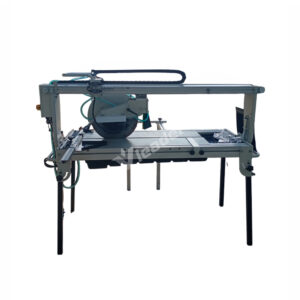
The VBS-400PRO is the most powerful and deepest-cutting of the four. It features a 2.2 kW motor and a Ø350-400 mm blade, with a maximum cutting depth of 132 mm, a maximum cutting length of 1200/1600/2500/3000 mm, a workbench size of 1310×500 mm, and a net weight of 118 kg. It also offers laser positioning for automatic cutting and three-in-one cutting, and is designed for thicker stone and large-format panel processing.
11. Blade Selection for Tile Cutting
Tile chipping is closely related to blade selection. Blades can be broadly divided into two categories according to the material being processed.
1. Conventional Materials: Dry Cutting, Wet Cutting, and Coated Blades
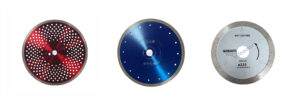
For ordinary ceramic tiles and conventional tile materials, dry cutting, wet cutting, or coated blades can be selected according to the equipment and process conditions. Dry cutting is convenient but generates more dust; wet cutting provides better cooling and a cleaner cut; coated blades suit scenarios with higher edge-quality requirements. Each method has its own applications — the key is matching it to the tile material and equipment.
2. Super-Hard Materials: High-End Blades
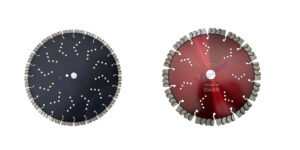
For super-hard materials such as vitrified tiles, full-body tiles, and sintered stone, specially designed high-end blades should be used. These blades are optimized in abrasive type, bond strength, and sharpness for high-hardness materials, effectively reducing cutting resistance, minimizing chipping and edge breakage, and extending service life.
Superfine Prealloy Diamond Blades
Main features: Laser-welded superfine prealloy diamond blades are used for nearly cutting all hard materials, including reinforced concrete, granite, clay blocks, and hard pavers.
12. Summary
Overall, reducing tile chipping can be approached from five angles: tool, equipment, parameters, material, and operation — choose a high-quality blade suited to the material; keep the guide rail and cutting mechanism stable; control cutting speed and depth reasonably; make sure the tile sits stably with sufficient support; and avoid sudden acceleration or forced correction during operation.
For large-format, thicker, or harder tiles, a cutting plan should be tailored to the material, and trial cuts can be made when necessary, adjusting parameters by observing the cut condition. The VBS-150A and VBS-150PRO support automatic, manual, and hand-cranked control, so the operator can switch modes flexibly based on trial-cut results; the VBS-400PRO’s 2.2 kW motor and Ø350-400 mm blade can handle thicker material and larger cutting loads.
In the end, chipping is rarely caused by a single factor. More often, it comes from a combination of things — the wrong blade, a loose component, poor feed-speed control, or an unstable tile placement. Go through these one by one, and the chipping rate will come down. For enterprises or construction units with large processing volumes, fixing equipment maintenance and operating procedures is more effective than adjusting parameters on the fly — it keeps cutting quality stable and cuts down on material waste.